It was an ordinary evening when Mike York, the hands behind some of the most expressive faces in God of War Ragnarök and Death Stranding 2: On the Beach, clicked play on a Digital Foundry video. He expected a dry technical breakdown of Nvidia’s latest magic trick, DLSS 5. Instead, what unfolded on his screen made him lean forward, squint, and eventually throw his hands up in sheer disbelief.
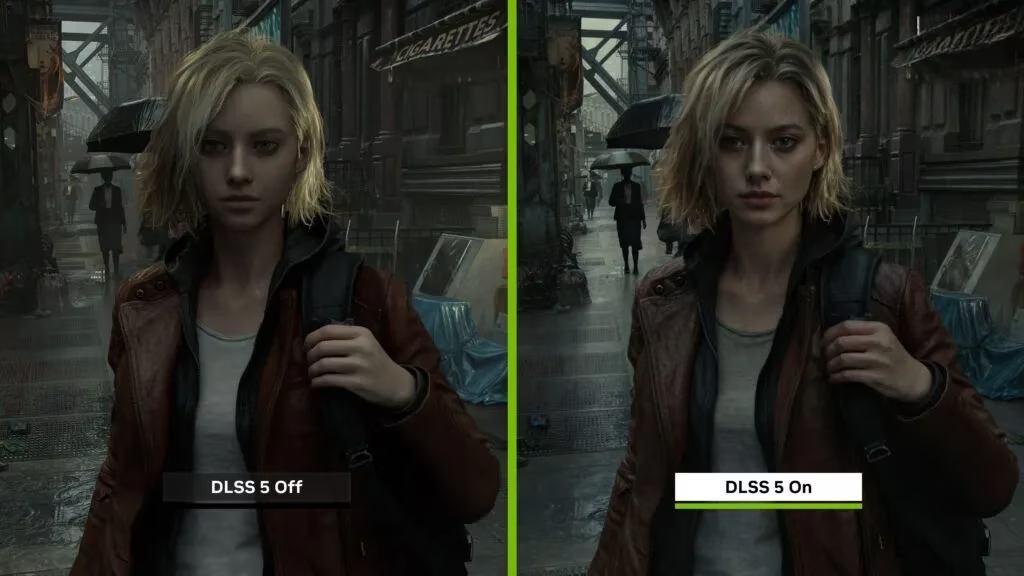
The showcase star was Grace Ashcroft, the haunted protagonist of Resident Evil Requiem. Nvidia had promised richer lighting, finer textures—the usual generational hop. But the Grace that appeared on York’s monitor wasn’t just polished; she had been re‑imagined by an unseen digital artist. Her eyes no longer aligned quite right. Tiny creases had bloomed around her lips like a story suddenly aged. The familiar face had become a stranger wearing a familiar name.
“Whoa, hold on,” York muttered, pausing the video. He wasn’t watching an enhancement anymore. He was watching a second creation. “No, no, no, no…” he repeated, his voice climbing. “This isn’t just some lighting, dude. What the f—… I’m telling you, this is like a complete AI re‑render.” His words hung in the air of the stream, equal parts awe and alarm.
The veteran animator couldn’t let it go. “Who even is that? That’s a different girl,” he said, pointing at the mismatched gaze. One eye looked left while the other drifted elsewhere, a subtle betrayal of the machine’s hand. York traced the details with the care of a craftsman examining a counterfeit: “It has somehow put wrinkles into her lips that weren’t there before… added all kinds of details that were not there before.” He leaned back, the weight of realisation pulling his shoulders down. “They’re literally re‑rendering this completely, frame by frame. You’re no longer looking at the game anymore, does that make sense? This is scary.”
The silence that followed was the kind of silence that only honest tech can create. DLSS 5 hadn’t simply cleaned up a frame; it had taken the director’s chair and rewritten the character’s biography. And that, York seemed to say, was the heart of the horror—not the zombies, but the notion that a player might never truly see the game the artists intended.
Nvidia, for its part, saw a masterpiece where York saw a mask. In carefully worded statements, the company insisted that developers hold the reins. “Game developers have full, detailed artistic control over DLSS 5’s effects,” Nvidia wrote, as if reciting a mantra. The SDK, they explained, offered intensity sliders, colour grading, and masking tools to carve out sacred zones—a face, a signature scar—where the AI should never tread. “It’s not a filter,” the message underlined, “DLSS 5 inputs the game’s colour and motion vectors for each frame into the model, anchoring the output in the source 3D content.” In plain English: we’re not just slapping makeup on a screenshot; we’re re‑dreaming the frame from the original bones.
Yet the studio walls told a different story. Whispers from within Capcom and Ubisoft painted a picture of bewilderment. One unnamed Ubisoft developer confessed that they learned about DLSS 5 the moment the whole world did—when Jensen Huang strode across a virtual stage and hit play. Artists who had poured months into a character’s subtle asymmetry suddenly saw an alternate version broadcast to millions, without a single late‑night email or creative sign‑off. The revelation stung: the painter wasn’t invited to the gallery opening.
Even Huang himself stepped onto the defensive, a rare posture for a CEO who usually commandeers keynotes with prophetic calm. “Critics are completely wrong,” he fired back. “DLSS 5 fuses controllability of the geometry and textures and everything about the game with generative AI.” It was a statement meant to soothe, but it arrived like a parent promising the car won’t drive itself—while the car is already merging onto the highway.
What gnaws at the edges of this debate is not whether DLSS 5 is technically brilliant (it is) but whether the studio’s “artistic control” is a gentle suggestion or a locked door. York’s reaction wasn’t the grumble of a Luddite; it was the gasp of someone who has spent a career sculpting micro‑expressions, only to see them overwritten by an eager, tireless machine that never blinks. The animator’s stunned pause said more than any press release could: we’re entering an era where the final frame is no longer a photograph but a negotiation—between the soul of an artist and the unblinking eye of an AI that dreams in vectors.
For now, gamers are left peering at screens a little harder, wondering whose vision they’re actually seeing. Is it Capcom’s Grace, or Nvidia’s? And if the difference is this stark in a controlled demo, what will happen when DLSS 5 wanders into the wild, unsupervised, re‑interpreting grief and joy one frame at a time? Somewhere, an animator is holding their breath. So should we. 🎭