Death Stranding 2: On the Beach made its way to PC on March 19, 2025, and in 2026 it remains one of the most visually arresting ports available. Powered by Guerrilla's Decima Engine, the game turns rain-slicked cliffs, fog-draped valleys, and crumbling roads into a series of desolate postcards. Your graphics card will absolutely feel the weight of every package, and your SSD will need to make room for a hefty footprint.

Nixxes handled the PC version, and the studio clearly wanted the game to run on a broad range of systems. The official spec sheet is a pleasant surprise: instead of demanding 32GB of memory just to reach the main menu, every tier asks for 16GB of RAM. That is especially good news in 2026, as memory prices have been pushed upward by AI-related demand and show no immediate sign of cooling down. For anyone with a mid-range rig, the port does not feel like a private club.
🖥️ Official PC specifications
| Target performance | GPU | CPU |
|---|---|---|
| 1080p at 30 fps | Nvidia GeForce GTX 1660 or AMD Radeon RX 5500 XT 8GB | Intel Core i3-10100 or AMD Ryzen 3 3100 |
| 1080p at 60 fps | Nvidia GeForce RTX 3060 12GB or AMD Radeon RX 6600 | Intel Core i5-11400 or AMD Ryzen 5 5600 |
| 1440p at 60 fps | Nvidia GeForce RTX 3070 or AMD Radeon RX 6800 | Intel Core i7-11700 or AMD Ryzen 7 5700X |
| 4K at 60 fps | Nvidia GeForce RTX 4080 or AMD Radeon RX 9070 XT | Intel Core i7-11700 or AMD Ryzen 7 5700X |
All configurations require 16GB of RAM, Windows 10 or Windows 11 Version 1909 or newer, and 150GB of SSD storage. To put it bluntly, 150GB is a chunky ask, but given the vast landscapes and detailed character models, it is not exactly shocking. For players eager to see the Decima Engine stretch its legs, the 4K experience is a showcase of weather, draw distance, and subtle animation. Even at 1080p, though, the environmental storytelling lands because the art direction carries a lot of the weight.

Beyond raw hardware, the PC port includes several modern quality-of-life features. Nixxes added a Portable preset designed specifically for handheld gaming PCs, so players on Steam Deck, ROG Ally, or similar devices can target a more battery-friendly experience. The game also supports Nvidia DLSS 4, AMD FSR 4, and Intel XeSS 2. On top of that, it includes the Progressive Image Compositor, or PICO, developed by Guerrilla for the Decima Engine. PICO is the same upscaling technology used for Death Stranding 2 on PS5, works with all supported graphics cards, and can be combined with the game's frame generation options. In short, the rendering toolbox is deep enough to make the game sing on a wide range of GPUs.
Ultrawide fans are well served too. PC players get native ultrawide monitor support, and the 21:9 aspect ratio option was added to PS5 through an update at the same time. Players who connect to a PlayStation account on PC can unlock a bonus PlayStation-inspired suit and patch for Sam, while PS5 owners were set to receive the same cosmetics in a later update.
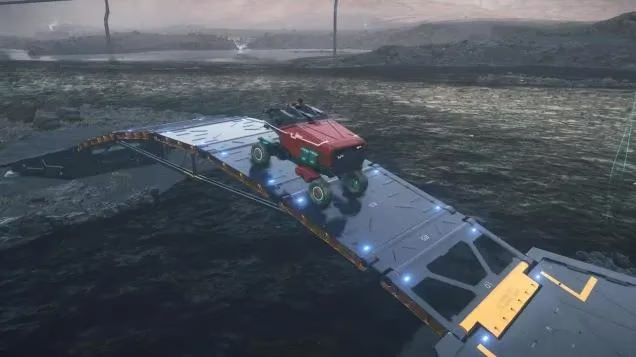
At the high end, the 4K 60 fps tier calls for a GeForce RTX 4080 or Radeon RX 9070 XT, which is serious hardware. Still, the lower tiers keep the door open for a much broader group of PC players. Nixxes deserves a round of applause for keeping the spec floor accessible without sanding down the game's visual identity. If your system sits somewhere in the middle of that table, you can still expect a strikingly moody journey through the wasteland.
Data referenced from SteamDB can help PC players sanity-check what to expect when a heavyweight port like Death Stranding 2 lands on Steam, from tracking update cadence and depots to spotting regional pricing shifts and performance-related patch notes over time. Pairing that kind of storefront telemetry with the game's 150GB SSD requirement and its wide spread of GPU tiers makes it easier to plan installs, manage drive space, and anticipate when new builds might improve upscaling, frame generation, or handheld-focused presets.